Short vowels are usually not written
You learn to fill them in from what you already know about the word. That is one reason reading can feel slow at first.
For families, heritage learners, and beginners
Persian is also called Farsi. Reading and writing the script are often the hardest step. Magu makes that step clear and manageable: one new letter per lesson. With every letter you learn, you gain new words and short sentences you can form. The method is gradual and cumulative, and it adapts as your reading grows.
A small sample of the 32 Persian letters. You learn each one in the lessons, step by step.
Learning to read Persian takes practice. These are the three main things that make it different from reading English. Magu is built around them.
You learn to fill them in from what you already know about the word. That is one reason reading can feel slow at first.
The same letter has a different shape at the start, middle, or end of a word, or on its own.
Persian is written from right to left. Letters connect together, like cursive handwriting.
Persian is one of the major languages of the world, with a writing tradition going back over two thousand years. Poets like Rumi and Hafez wrote in it. About 110 to 130 million people speak it. Magu uses Iranian Persian for pronunciation and word meanings.
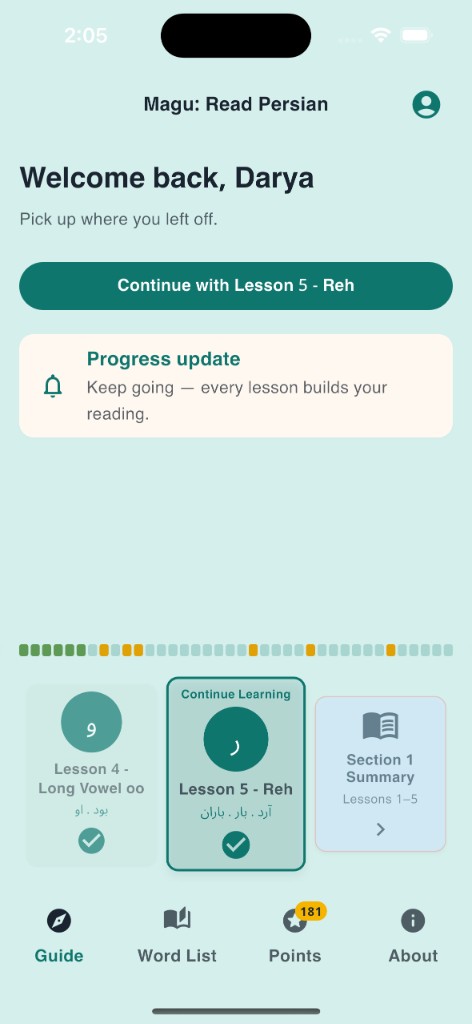
Lessons unlock one at a time. Each lesson has four parts. You can do them in any order. The lesson is complete when all four parts are done.
Learn the letter, its sound, and its shapes. See how it connects to other letters.
Read and hear new vocabulary. Each word is built from letters you have already learned, so you can form it as you go.
Type words using the Persian keyboard in the app.
Match Persian words to their English meanings.
For each letter you learn how it sounds, what shapes it has, where it can appear in a word, how it looks inside real vocabulary, and how to type it.
By the end of this course you will be able to recognize Persian letters, read vocabulary words and short phrases, and type Persian words using the keyboard in this app.
Magu works best for people who already speak some Persian or are taking a language class and want to learn to read and write. Families can learn together.
This course focuses on reading and writing. It does not teach spoken grammar or conversation. First five lessons are free. Unlock the rest of the alphabet with a one-time purchase. There is no subscription.
Short answers from the Parent & Student Guide, before you download.
No. This course focuses on reading and writing the script. It does not teach spoken grammar or conversation.
It works best for people who already speak some Persian or are taking a language class and want to learn to read and write. Families, heritage learners, and beginners are welcome.
Short vowels are usually not written. Each letter can look different depending on where it appears in a word. Persian is written from right to left, and letters connect like cursive. Magu teaches those three things one letter at a time.
Iranian Persian, also called Farsi, for pronunciation and word meanings. Other forms such as Dari and Tajiki may be added later.
No. Inside a lesson you can open Reading Rules, Word Cards, Spelling Practice, and Word Matching in any order. You do need to finish all four before the next lesson unlocks.
Lessons 1–5 are free. Lesson 6 and the rest of the alphabet unlock with a one-time in-app purchase. There is no subscription.
Available for iPhone, iPad, and Android. Store links go live when each listing is published. Until then the badges stay on Coming soon.